
Transfer season is here — and the change-of-residence rule has changed.
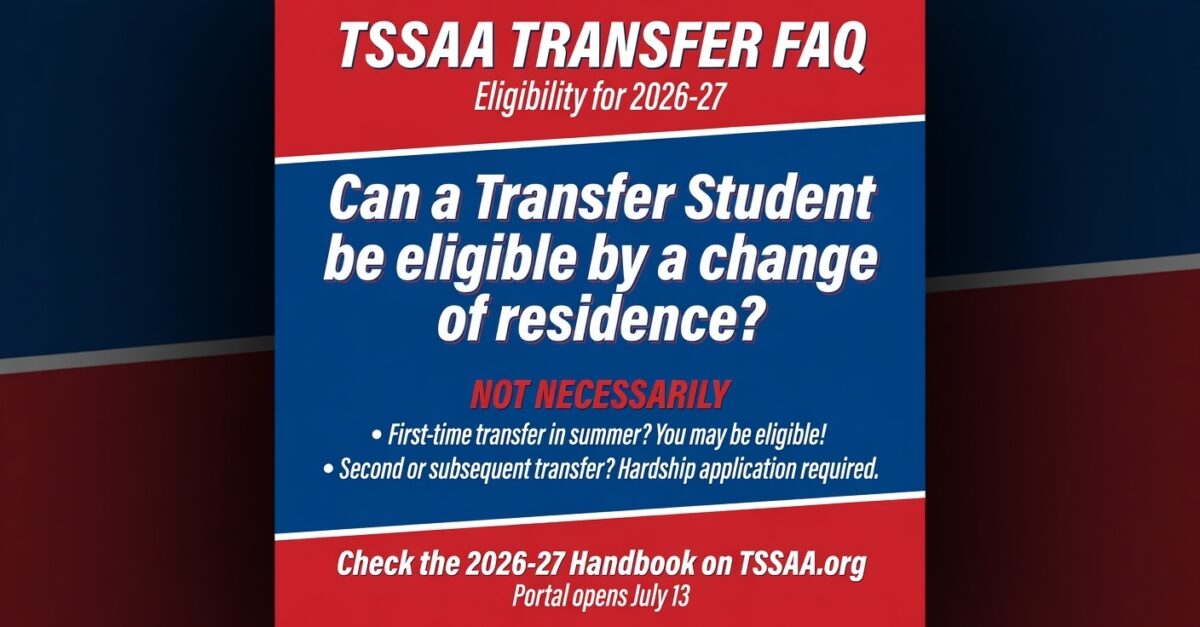
Can a Transfer Student still be ruled eligible by virtue of a bona fide change of residence?
Not necessarily.
If it is the student’s first time to transfer schools since initially establishing their athletic record, and the transfer is made during the summer between school years, the student will meet the new “first-time transfer rule” and will be eligible, provided they meet all other rules.
If it is a second or subsequent transfer (even if due to a change of residence), the student does not meet the new transfer rule. There is no longer a separate provision in the bylaws to allow eligibility based solely on a bona fide change of residence. With the implementation of the new transfer rule, most of the old transfer provisions have been removed from the bylaws.
Transfers and Hardships in the 2026-27 TSSAA Handbook
The updated TSSAA bylaws, which include information about the new transfer provisions, can be found on the TSSAA.org website. Information on students changing schools appears on pages 15 and 16. Frequently asked questions for students changing schools can be found on pages 45 and 46.
2026-27 Constitution and Bylaws (PDF)
Transfer students and hardships may be submitted only after the student meets the TSSAA definition of “enrolled” at the new school, either by participating in three or more days of official practice for a fall sport after the first official day of practice as defined by the TSSAA Sports Calendar or by attending at least three days of classes at the new school.
As always, school administrators will be able to submit a hardship application for transfer students who are ineligible. Except for the eligibility rules in regard to age and to the number of semesters in school, TSSAA shall have the discretion to set aside the effect of any eligibility rule upon an individual student in an exceptional case when: (a) the circumstances causing the student to fail to satisfy the eligibility rule were unforeseen or unavoidable; (b) application of the rule to the student works an undue hardship in light of the unforeseen or unavoidable circumstances; and (c) application of the rule would not accomplish the purpose or purposes for which the rule was intended;
The hardship application will have a bit of a new look this year, particularly for situations where there is a change of residence, and it is not the student’s first time transferring since establishing an athletic record. Some of the questions you may anticipate on the hardship application for students who have transferred as a result of a change of residence when it is not their first transfer are as follows:
- Why was this change of residence made? (e.g., job relocation, eviction, safety, change of custody, etc.)Has the previous residence been disposed of? (e.g. lease terminated, property sold, property rented out, all family belongings removed, utilities shut off, etc.)
- Did the former school district allow the student to remain enrolled at their former school after the move, or did the change of physical residence force the student to change schools due to district policy?
- What was the student's primary mode of transportation to their former school?
- What is the student’s primary mode of transportation to their new school?
- What was the driving distance/time from the former residence to the former school?
- What is the driving distance/time from the new residence to the former school?
- What is the driving distance/time from the new residence to the new school?
TSSAA Portal Update
The TSSAA Portal should open up for transfer form submissions on July 13. The TSSAA Portal is the information hub the organization uses for student eligibility, access to online rules meetings, directory information, etc. If you have not had experience navigating the TSSAA Portal, the links below can help you get started.
TSSAA Transfers in 2026 27

